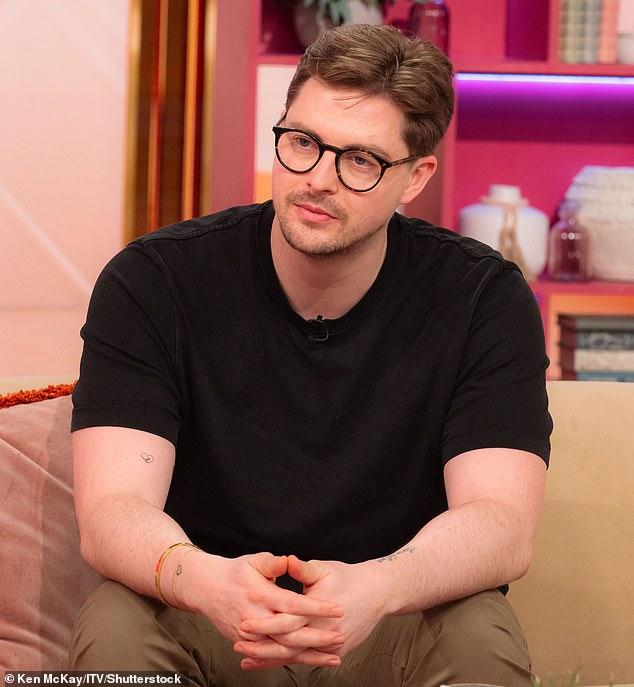
Dr Alex George has revealed he has been diagnosed with autism.
The Love Island star, 34, updated his Instagram followers on Tuesday, after previously sharing that he was undergoing the assessment.
Dr Alex said the news that he is autistic ‘feels raw’ and while it will take a while to process, it will help him to understand ‘why I am the way I am’.
Autism, or autism spectrum disorder (ASD), refers to a broad range of conditions characterised by challenges with social skills, repetitive behaviours, speech and nonverbal communication.
The television personality was diagnosed with Attention Deficit Hyperactivity Disorder (ADHD) in September 2022. Then last year, in 2025, he was diagnosed with Obsessive Compulsive Disorder (OCD).
Dr Alex wrote: ‘I actually don’t know where to start or how to even approach this, so I’m just going to say it. I am autistic.

Dr Alex George has revealed he has been diagnosed with autism. The Love Island star, 34, updated his Instagram followers on Tuesday

Dr Alex said the news that he is autistic ‘feels raw’ and it will take a while to process, but it will help him to understand ‘why I am the way I am’

He wrote: ‘Just wanted to update and share with you all. I have been diagnosed with autism and I am still trying to get my head around it. Thank you for the support, appreciate you x’
‘I was diagnosed recently after going through the in-depth assessment process. Sitting and reading the 300-odd-page report was the most surreal and strange experience of my life.
‘I had to take some time to let it all sink in. The words “gosh I really do sound autistic” did come to my mind.
‘I can’t explain how weird it is to be able to understand what I never could see. I feel a little unnerved, confused and unsteady I guess. Not because I think it’s a bad thing or even a good thing, it’s just a lot, you know?
‘My psychiatrist, who has encouraged me for a long time to be assessed said to me that I will only understand the value of the diagnosis when I go through the assessment process. And I get that now 100%.
‘I can finally see and begin to understand why I am the way I am.
‘I have all the pieces of the jigsaw at last. It only took 34 years.’
Dr Alex went on to say how he thinks the diagnosis will help with his relationships and for others to understand him.
The reality star said certain routines he had in place like bringing a hair dyer everywhere he goes and missing out on social cues now make sense.

Dr Alex found fame on the 2018 series of Love Island and has since used the platform to document his journey as a doctor


Dr Alex was flooded with supportive messages from his fans, who commended his bravery
He continued: ‘There is so much to say and in time I will say more. But right now I just wanted to get this weight off my shoulders, I feel as if I am keeping a secret. Because this page has always been about sharing my experiences in the hope someone out there doesn’t feel alone.
‘I am still figuring out what that means for me but right know I just wanted to let you know, I am autistic.
‘Thank you for the doctors who looked after me, my family and loved ones who took part in a process that isn’t easy for them at all. Especially my mam. I love you so much.
‘This is still so raw and new to me. I have a lot to process so I do need time for this to sink in fully.
‘I will leave you with this thought.
‘The greatest gift we can give ourselves, is the gift of acceptance. And for that to happen, we need to know who we truly are.’
Dr Alex was flooded with supportive messages from his fans, who commended his bravery.
They wrote: ‘You’re wonderful! Don’t ever doubt that’;
‘That’s brave of you to tell us. It’s going to take time but know you are loved and have support from family, friends and us on here who stand with you. Xx’;
‘Thinking of you and glad you could share this’; ‘We’ve got you. Thank you for sharing.’
Last month, Dr Alex detailed his ‘exhausting battle to be normal’ in a column for The Telegraph.
The former Love Island star said since childhood, he had suffered crippling anxiety and for years believed if he had a ‘normal job’ and a ‘normal social life’, he would be okay; however, he always felt different.
Alex said even now, people still don’t fully understand what ADHD really is, adding that the name ‘attention deficit hyperactivity disorder’ doesn’t help either, as it implies people with ADHD can’t concentrate and are always hyperactive.
However, Alex firmly stated it’s not the case, and the condition is best understood as a ‘dopamine-driven dysregulation disorder’.
He added: ‘Looking back, the signs were always there. ADHD babies don’t sleep and the term ‘sensitive’ crops up time and again. Sensory things overwhelmed me, routine was crucial.’
According to ADHD UK, Attention Deficit Hyperactivity Disorder is a disorder that is defined through analysis of behaviour.
People with ADHD show a persistent pattern of inattention and/or hyperactivity – impulsivity that interferes with day-to-day functioning and/or development.
Alex also shared at the age of 11, he developed facial tics, but no one, including his parents, investigated it, and he only realised because his face ‘hurt’ from doing it so much.
Alex revealed the tics are now located in his hands, shoulders, and neck.
He revealed he has tried getting Botox to freeze the muscles; however, when he feels particularly stressed, they inevitably become worse.
Within his column, Alex, the eldest of three siblings, also opened up about how he spent his childhood days mostly outdoors and how, as a teen, he found comfort in the sound of hairdryers.
He shared he still uses hairdryers to self-soothe and ensures he packs his BaByliss hairdryer with him whenever he goes away, otherwise, he would be ‘anxious without it’.
Alex also opened up about his OCD diagnosis, admitting since childhood, he has been a worrier and obsessed over ‘what ifs’.
He discussed how people believe the medical condition is about cleaning or checking things over, as those are the visible things, however, he explained that most OCD is internal, adding its ‘obsession’, rumination, and compulsion.
However, for himself, he sought reassurance and would think about things for months or replay a conversation over in his head, wondering if he had been rude or not.
He added for himself, he found the best treatment is exposure – saying maybe things will happen or they won’t – and not checking, not ruminating, nor seeking reassurance, just sitting with the ‘discomfort’.