
After the BBC faced backlash for not editing out a racial slur during the 2026 BAFTA Awards, attention has turned to the circumstances surrounding the on-air moment.
Host Alan Cumming was forced to apologise on Sunday night after John Davidson was heard yelling the N-word during a presentation by Michael B. Jordan and Delroy Lindo.
He confirmed the remark was made by John, who has Tourette’s syndrome, and explained it resulted from involuntary verbal tics, stressing it was not intentional.
Tourette’s syndrome is a condition that usually begins in childhood and is characterised by involuntary motor and vocal tics.
The incident has since reignited debate around live broadcasting, public language and how neurological conditions are perceived.
Against this backdrop, celebrities including Billie Eilish and Lewis Capaldi have helped shift the focus to understanding the neurological condition by speaking openly about their own experiences.

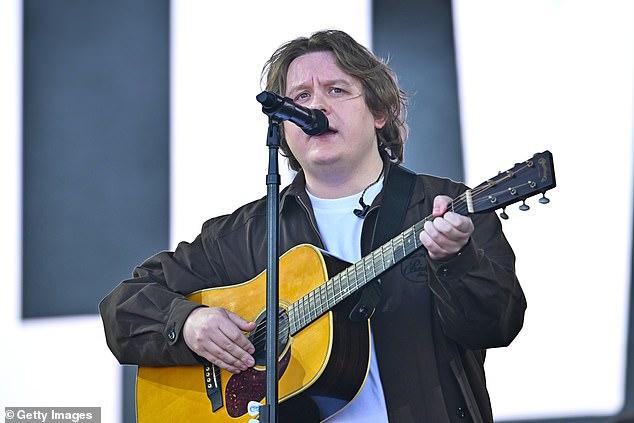
Celebrities including Billie Eilish and Lewis Capaldi (pictured) have helped shift the focus to understanding the neurological condition Tourette’s Syndrome by speaking openly about their own experiences

Tourette’s syndrome is a condition that usually begins in childhood and is characterised by involuntary motor and vocal tics. Pictured: Billie Eilish
Lewis Capaldi
Lewis Capaldi has been open about his diagnosis with Tourette’s Syndrome.
The hitmaker, 29, went public with his diagnosis in September 2022, since he didn’t want people to think he was taking cocaine.
Speaking about how he manages the condition at the time, Lewis admitted that performing can make his symptoms worse as he shared his fears about having to give up music.
He explained that there is a ‘real possibility’ that he will have to quit his career as a pop star if he starts causing ‘irreparable damage’ to himself.
He candidly told The Times: ‘It’s only making music that does this to me, otherwise I can be fine for months at a time, so it’s a weird situation.
‘Right now, the trade-off is worth it, but if it gets to a point where I’m doing irreparable damage to myself, I’ll quit.
‘I hate hyperbole but it is a very real possibility that I will have to pack music in.’
The Grace hitmaker said his Tourette’s has made performing live – the part of his job he enjoys the most – more challenging as his tics are getting ‘quite bad’ on stage.

Leiws, 29, went public with his diagnosis in September 2022, since he didn’t want people to think he was taking cocaine
In June 2025, Lewis made a triumphant return to the stage for a secret Glastonbury set, in conjunction with the release of new single Survive.
The Scottish singer was greeted with cheers from the huge Worthy Farm crowd, two years after his battle with Tourettes left him unable to finish his perfomance at the festival and led to a career hiatus.
Delighted to be back in front of an audience, he tearfully said: ‘Two years ago I wasn’t sure if I’d ever do this again, but I’m back baby!’
Lewis sang a number of his famous hits, before choking back tears as he performed his brand new single Survive, which highlights the difficult period in his career following his last Glastonbury gig.
Fans in the crowd could be seen crying and calling out his name before joining him in a rendition of megahit Someone You Loved.
In his emotional speech, Lewis said: ‘Glastonbury it’s good to be back. Won’t say too much up here today as if I do I might start crying, but I can’t thank you enough for coming here and being with here’.
‘Second times a charm hey! It’s a short set today but just wanted to come and finish what I couldn’t last time, also this was like the worst kept f*****g secret ever’.
During his last performance at Glastonbury two years prior, Lewis was coming out of a three-week mental health hiatus he had taken to ‘rest and recover’.
Returning to the stage, the singer admitted he had been ‘s**t scared’ to perform as he opened up about his mental health struggles and battle against Tourette’s.
In the middle of his set, Lewis confessed that he was struggling with his Tourette’s and said his voice had ‘packed it in’, after coughing throughout the show.
However, his supportive fans rallied around him, with the show coming to an heartwarming close as the supportive crowd sang out his hit Someone You Love at the top of their voices.
Lewis emotionally left the stage, saying: ‘Glastonbury, I’m really sorry. I’m a bit annoyed with myself’.
Afterwards, he announced he would be ‘taking a break for the foreseeable future’ as it was ‘obvious’ he needs to spend ‘much more time getting my mental and physical health in order’.
The hitmaker, who had been due to embark upon a world tour, explained he needed time to ‘adjust to the impact’ of living with Tourette’s, admitting it was ‘the most difficult [decision] of my life’.
Billie Eilish

Billie Eilish was diagnosed with Tourette’s when she was 11 years old
Billie Eilish was diagnosed with Tourette’s when she was 11 years old.
The singer, 24, addressed the neurological disorder after having a tic while appearing on season four of David Letterman’s Netflix talk show My Next Guest Needs No Introduction in 2022.
‘I’m very happy to talk about it,’ the Grammy-winning singer told David.
‘I actually really love answering questions about it because it’s very, very interesting, and I am incredibly confused by it and I don’t get it,’ Billie added.
The Los Angeles native then explained the extent of the condition.
‘I don’t tic at all, because the main tics that I do constantly, all day long, are like, I wiggle my ear back and forth and raise my eyebrow and click my jaw … and flex my arm here and flex this arm, flex these muscles.
‘These are things you would never notice if you’re just having a conversation with me, but for me, they’re very exhausting,’ Billie said.
The singer added that opening up and talking about Tourette’s made the ‘Bad Guy’ singer realise she is not alone.
In 2019, Billie admitted that she did not want to be just known for having the neurological disorder.
She told Stellar: ‘I’ve had Tourette’s since I was 11, but it was not something I wanted to be defined by.
‘I know how people work: if I were to make it a very known thing, then it would be “Billie Eilish, the artist with Tourette’s”.’
Seth Rogen

Seth Rogen has openly discussed having a ‘very mild’ case of Tourette’s syndrome
Seth Rogen has openly discussed having a ‘very mild’ case of Tourette’s syndrome.
In January 2021, he revealed on X that he has Tourette’s syndrome, which runs in his family.
The Emmy-nominated actor shared his experience and explained that he has a ‘very mild case’ of Tourette’s, which mainly ‘manifests in twitching.’
He also commented that there have been several cases of this condition in his family.
That same year, he admitted it would be ‘really hard’ for him to live without marijuana after smoking the drug helped his low-level OCD and Tourette’s.
While covering the cover of British GQ’s magazine, he said that people are ‘still weird’ about cannabis despite it being legalised for medical use in 35 US states.
Seth explained that he’s smoked marijuana to help his obsessive-compulsive disorder and Tourette’s, which are low-level but more pronounced in his father.
Asked whether he could live without the drug, he said: ‘It would be like saying you can’t wear clothes anymore. It would be a real bummer. It would make it really hard for me to do what I need to do in the world.’
‘The only stigma with weed is because it affects your brain. And people are just weird about it. They don’t like talking about brain health.’
Currently, marijuana is legal for medical use in 35 states, including California, Nevada and Vermont, while 15 have also made the drug legal for recreational use.
Tim Howard

Tim Howard was diagnosed with Tourette’s when he was in sixth grade.
Tim Howard was diagnosed with Tourette’s when he was in sixth grade.
Rather than a hindrance, the footballer, 46, describes his neurological makeup as a competitive advantage.
‘At the age of 18 or 19 I realised I was faster than others when it came to certain movements, and that these reflexes were linked to my disorder’, he told Spiegel in 2013.
The former Manchester United star rejects suggestions that it had negatively impacted his career.
He said: ‘For me, it’s been a blessing in my life. I don’t see it as a negative. It’s who I am. And I like who I am. It’s like breathing to me.’
In 2014, he revealed plans to work with fellow sufferers of Tourette syndrome when he retires.
He said he has an extensive list of things he wants to do when he finally stops playing, but working with young people who have the condition is high on his list.
‘We have started an advocacy, an awareness academy in New Jersey,’ Tim told The Telegraph.
‘What we try to do is not only on a grass-roots level, to help the kids with their self-esteem but with the advocacy programme we are giving them tools to be advocates for themselves.
‘If you look at Hollywood, it’s very misunderstood. There it’s just about cursing and they are trying to get a laugh. But it affects people on a daily basis and, for us, that is the focus.’
Tim retired from playing football after the 2019 season.
Dan Aykroyd

Dan was diagnosed with Tourette’s when he was 12
Dan was diagnosed with Tourette’s when he was 12.
The actor, 73, told the Daily Mail in 2013: ‘I had physical tics, nervousness and made grunting noises and it affected how outgoing I was.
‘I had therapy which really worked, and by 14 my symptoms eased.
‘I also have Asperger’s but I can manage it. It wasn’t diagnosed until the early Eighties when my wife persuaded me to see a doctor.
‘One of my symptoms included my obsession with ghosts and law enforcement – I carry around a police badge with me, for example.
‘I became obsessed by Hans Holzer, the greatest ghost hunter ever. That’s when the idea of my film Ghostbusters was born.’
Lele Pons

Since the release of her 2021 YouTube series, The Secret Life of Lele Pons, the social media star shared that she has secretly lived with Tourette’s syndrome her entire life
Since the release of her 2021 YouTube series, The Secret Life of Lele Pons, the social media star shared that she has secretly lived with Tourette’s syndrome her entire life.
The YouTuber, 29, admitted that she was able to hide her ticks from the world, but became emotional as she worked through them with her therapist on camera.
She said: ‘I have a lot of ticks, my head hurts. I’m just like embarrassed right now.
‘I’m just crying because they are filming. If I was here with just you, you wouldn’t judge me.’
She continued: ‘All those ticks come into one. I’m ashamed of having ticks. I’m motivated to get better. I don’t want to continue like this.’
After the release of her YouTube series, Lele shared that it was her mission to educate others about mental health and wellness.
She told E! News: ‘I am very, very grateful to have helped a lot of people, grateful to have had the chance to educate people who don’t know what OCD and Tourette’s are.
‘It’s very important to actually also push people to get better, take their medicine, go to get help, go to get a good support system, to help parents understand their kids have whatever they have, help to understand that it is not something that’s going to define you.
‘It’s not something you should be ashamed about. And I wanted to show that to everybody.’