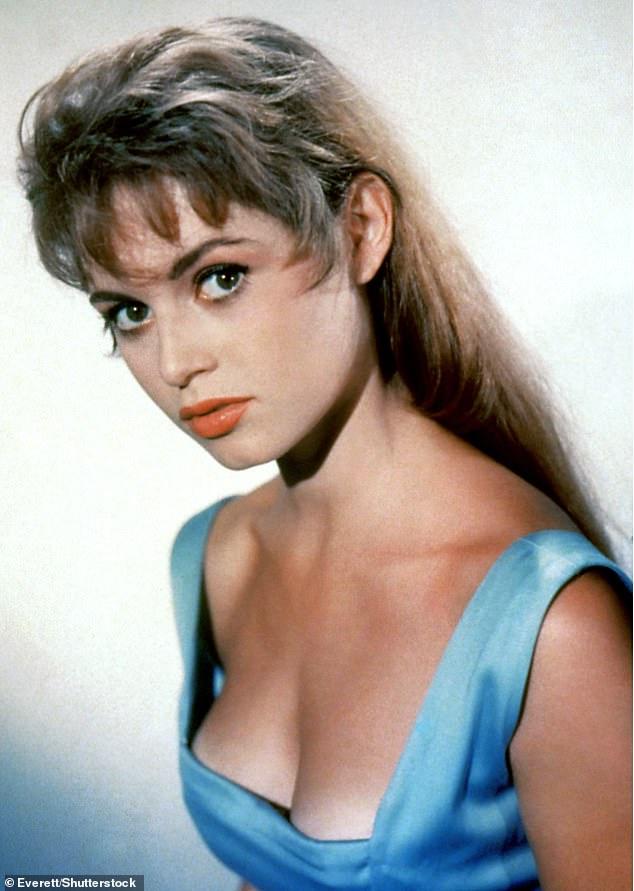
Bardot. There aren’t many surnames entirely synonymous with sexual allure, but in the 1950s there were two. The other was Monroe, another powerfully evocative six-letter name, but I would argue Brigitte Bardot had a global impact, on men and women alike, that was unmatched even by Marilyn Monroe and all the fanfare of Hollywood.
The 1956 French-language film And God Created Woman made her not merely a star but an international sensation. And her appeal transcended the generation gap, too.
In 1967 she was invited to meet the French president Charles de Gaulle at the Elysée Palace, where women were banned from wearing trousers as evening wear.
In an audacious breach of protocol, Bardot turned up dressed as a Napoleonic hussar, blonde locks tumbling over her epaulettes. De Gaulle, then in his late seventies, was transfixed, solemnly declaring her to be a ‘French export as important as Renault cars’.
A few years earlier in Liverpool, the teenage John Lennon stuck a poster of Bardot to his bedroom ceiling, all the easier to fantasise about, and later persuaded his wife Cynthia to copy her fashion sense, her bed-head hair and her copious use of eye-liner. When he finally met her in 1968, by which time his fame had arguably outstripped hers, the incorrigibly outspoken Beatle remained completely tongue-tied, despite having taken a tab of acid to conquer his nerves.
The following year, Bardot became the first real-life model for Marianne, the fictitious emblem of the French Republic, personifying liberty, equality, fraternity and reason – a bust of whom is displayed in every town hall.
Her death, at the age of 91, was announced on Sunday just weeks after the animal-welfare foundation that carried her name denied reports of her diminishing health after a ‘minor’ surgical procedure.
The current French president Emmanuel Macron led the tributes. ‘Her films, her voice, her dazzling fame, her initials, her sorrows, her generous passion for animals, her face that became Marianne – Brigitte Bardot embodied a life of freedom,’ he said. ‘A French existence, a universal radiance. She moved us. We mourn a legend of the century.’

Brigitte, pictured in 1955, began modelling before her film career took off when she met her first husband, Roger Vadim

Known as the original ‘Sex Kitten’, Bardot shot to international notoriety with her role in the 1956 film And God Created Woman, which was directed by her first husband Roger Vadim

Brigitte Bardot pictured smoking a cigarette after arriving in London, April 1959
The French hard-right leader Jordan Bardella declared that ‘she alone embodied an entire era of French history and above all a certain idea of courage and freedom’.
In fact, the dazzling celebrity and sex appeal of the young screen goddess with the tousled blonde hair and the come-hither pout had long since mutated into something much sadder. Bardot had become notorious for her overt, unapologetic racism, which saw her convicted five times in French courts for inciting racial hatred.
She claimed France had been ‘infiltrated’ by ‘sheep-slaughtering Muslims’ and did not restrict her provocative comments to what she furiously called the ‘Islamisation’ of her country. She also described gay people as ‘fairground freaks’.
She was infinitely nicer about animals, sharing her house (indoors as well as out) with a menagerie that at one time included a small herd of goats, a flock of ducks, donkeys, and numerous cats and dogs. Bardot’s animal-rights activism sometimes seemed half-crazed. However, she liked to explain her passion by drawing a parallel with her own younger self. ‘I know what it feels like to be hunted,’ she said.
It is certainly hard to overstate the response to And God Created Woman, the story of a wayward orphan who bewitches the male population of St Tropez.
By modern-day standards, it’s a pretty tame affair. At the time, it was explosive. Bardot’s coquettish performance throughout the film, but above all a scene in which she dances barefoot, her skin glowing with perspiration, hair loose and untamed, turned her, aged 22, into the most potent sex symbol of her age. Perhaps of any age.
In America, several states promptly banned the film altogether. In the Deep South, one racist governor actually warned that it might make ‘coloured men overheated’.
Elsewhere in the US, the National Legion of Decency picketed cinemas in which it was showing, with ‘Ban Bardot’ as their thunderous war cry.

Brigitte Bardot on the beach in Saint Tropez, 1984
In Britain, one critic denounced the film as ‘a crude piece of calculated pornography’. Another wrote more appreciatively that the sensual Bardot disturbed his ‘male equilibrium’.
All this, of course, was the best possible publicity. And God Created Woman, directed by Bardot’s then husband Roger Vadim, duly became a huge hit. Thereafter, men couldn’t take their eyes off her, nor photographers their lenses. All this horrified her extremely conservative Catholic parents. Yet she’d first been talent-spotted at a show promoting her mother’s millinery shop in Paris, and in May 1949, aged just 15, appeared on the cover of French Elle magazine.
A year later, Elle featured her again and among those entranced was film director Marc Allégret, who sent his assistant, Vadim, to meet her and her parents at their plush seven-bedroom apartment in Paris. Vadim implored her oppressively strict father to let her audition for a film he had written himself.
Louis Bardot, a wealthy industrialist, refused. Brigitte, the older of his two daughters, was training to be a ballet dancer, much more respectable than acting in raffish movies. But Vadim and Allégret persevered and eventually Brigitte was allowed to do a screen test – which she failed. Amazingly, the same audition process also overlooked another pair of hopefuls, Leslie Caron and the unknown Audrey Hepburn, and the film was never made.
As one of Bardot’s biographers later wrote, it was surely a record for casting blunders.
Still, Bardot’s promise as an actress was not foremost in Vadim’s mind. As soon as he set eyes on 16-year-old Brigitte in the flesh, he was intoxicated.
And she in turn was smitten by him – six years older, rakishly handsome, somewhat louche.
They became secret lovers, which so horrified her parents that they made plans to send her to boarding-school in England, only relenting when their headstrong daughter threatened to kill herself.

Brigitte was born into a wealthy family in Paris and began ballet lessons from a young age after her mother enrolled her for classes

A very young Bardot (pictured in 1951) began her modelling career sporting relatively conservative fashion

Bardot’s parents did not initially approve of her union with Vadim but agreed to her marriage after she attempted suicide. Above: Being walked down the aisle by her father, December 19, 1952

Brigitte with her second husband, Jacques Charrier, with whom she had a son, Nicolas

Bardot had little to do with her son Nicolas during his childhood after she gave Charrier custody of him when they divorced
Her mother mistrusted Vadim to the point that she used to check the silver whenever he’d visited their home. But when Brigitte put her head in the oven, her parents grudgingly agreed to let her marry him, as long as she waited until she was 18. The wedding, in December 1952, could hardly have been more traditional. Bardot, wearing a white velvet dress, was every inch the demure bride. But her conformism lasted only a day.
Soon, with her guileful husband masterminding a series of cover shoots for Paris Match magazine and with her brown hair dyed blonde, the former trainee ballerina was transformed in more ways than one. Powerless to intervene now that she was a married woman, her parents looked on, aghast, as the term ‘sex kitten’ was coined to describe her.
Her father tried to stop distribution of her second film, The Girl in the Bikini, which was promoted using shots of her bare ‘derriere’.
Bardot’s acting career had still barely got off the ground, however, when Vadim whisked her off to the 1953 Cannes Film Festival and ensured that she was photographed repeatedly in the company of established Hollywood stars such as Kirk Douglas, so that their fame would rub off, almost literally, on her.
The strategy worked brilliantly; she started getting media attention out of all proportion to her status as an actress. Her first English-speaking role, as a sexy nightclub singer and Dirk Bogarde’s love interest in the 1955 comedy Doctor at Sea, did not exactly showcase her acting talents. Yet at the Royal Film Performance in London in October 1956 she all but eclipsed the Queen, Princess Margaret and, a bit further along the receiving line, Marilyn Monroe.
The screening had nothing to do with Bardot; it was a war picture, The Battle of the River Plate. But by then her initials alone had the power to make grown men weak at the knees. The legend of BB was underway.
As her film career soared, her marriage soured. Indeed, even while making And God Created Woman she fell for her co-star Jean-Louis Trintignant, in one scene continuing to kiss him long after Vadim had shouted ‘cut!’
By 1960 she had divorced the controlling Vadim (who would later marry Jane Fonda), had an affair with the singer Sacha Distel, married actor Jacques Charrier and given birth to a son, Nicholas, her only child. It was not a planned pregnancy, to put it mildly. ‘I looked at my flat, slender belly in the mirror like a dear friend on whom I was about to close a coffin lid,’ she later wrote, of the horror of finding herself expecting a baby. She duly sought a discreet abortion in Switzerland but couldn’t find a clinic willing to oblige. With Bardot, at that time, there was no such thing as discreet.

Brigitte Bardot and French Academician Marcel Achard flanked by photographers attend the French artists Union Gala event at the Cirque d’Hiver in Paris on March 9, 1962

Pictured: Playboy Roger Vadim with Bardot on set. After meeting the model, the French film producer helped her become a star

Brigitte Bardot in a scene from the film Les Femmes, 1969
In those four eventful years from 1956 to 1960, according to a biographer, Bardot ‘was venerated and abused, imitated and attacked like no star before, and possibly since’. A survey at the time revealed that 47 per cent of all conversation in France was about Bardot (and only 41 per cent about politics). It was all too much for her. She had a nervous breakdown and made several more suicide attempts. In a recent documentary, Bardot, she claimed that she had suffered from depression all her life and that it had been greatly exacerbated by her extraordinary fame. ‘Every morning I wake up and I am sad,’ she said.
Her personal life lurched from one disaster to the next. She and Charrier were divorced in 1962, and she was denied custody of Nicholas. She later claimed in her bestselling 1996 autobiography, that she would have ‘preferred to give birth to a little dog’ rather than her son. The remarks triggered a legal battle with Charrier, and she was ordered to pay damages.
In Las Vegas in 1966, she married Gunter Sachs, a wealthy German playboy whose grandfather had founded Opel cars. Sachs had wooed her only hours after meeting her by dropping over a thousand red roses onto her home in the South of France, from a helicopter. Their union lasted three years.
The last and by far the most enduring of her four marriages was to businessman Bernard d’Ormale, a former adviser to the French National Front leader Jean-Marie Le Pen. But she was also conservatively estimated to have had at least 100 lovers, some of them women. Others included American actors Warren Beatty and Glenn Ford, and the French singer Serge Gainsbourg. The latter was so bowled over when he met her in 1967 that, just like John Lennon a year later, his normal charisma deserted him and he became as tongue-tied as a schoolboy.
Unimpressed, Bardot phoned Gainsbourg the following day, telling him that to win back her respect he would first have to create the most beautiful love song ever heard.
He duly wrote ‘Je t’aime … moi non plus’, which did the trick. They embarked on a passionate affair and recorded the song together while engaging in what a startled studio engineer described as ‘heavy petting’.
The gossip went a step further, suggesting that they had brazenly been making love, which caused Bardot, uncharacteristically and perhaps a little late in the day, to fret about her reputation. She begged Gainsbourg not to release the song, which he didn’t until he re-recorded it with a later lover, the British actress Jane Birkin.
In 1973, at almost 40 years old, her beauty undimmed but claiming ‘my soul is not my own any more’, Bardot abruptly quit acting. She had appeared in dozens of movies but never conquered Hollywood (most of her English-language films were flops) and never regarded herself as much of an actress.

Brigitte Bardot and James Bond star Sean Connery pose for a publicity shot during their first meeting in France before filming Shalako, 1968

Bardot became an animal rights activist. Above: Attending the international feline exhibition in Saint-Tropez, France, June 1977
It was an assessment with which plenty of critics agreed, yet it’s hard to think of anyone who made more of an impression on the silver screen. And she did star in some genuinely fine films, including La Verite or The Truth (1960), a powerful courtroom melodrama in which she plays a flighty young woman accused of murdering her lover.
In another highly-regarded picture, Louis Malle’s Vie Privee or A Very Private Affair (1962), she played a movie star hounded by the media. Ironically enough, she described the US publicity tour of that film as ‘insane’ and resolved never again to work outside France, turning down roles opposite Frank Sinatra, Steve McQueen and Marlon Brando.
Whatever the extent of her talent, she said that if she hadn’t stopped acting, ‘what happened to Marilyn Monroe … would have happened to me’. In the mid-1970s, after joining the campaign to stop the clubbing of baby seals in Canada, she pledged to devote the rest of her life to animal welfare.
From La Madrague, the home near St Tropez which she bought in 1958 at the height of her fame (helping to turn a little-known fishing village into the Riviera’s most fashionable resort), she did just that through her foundation, which was founded in 1986. In 1998 she even lent her weight to the Daily Mail’s campaign to save a collie cross called Woofie, a family pet ordered to be destroyed after chasing a policeman in Aberdeenshire.
Bardot flew to Scotland to make a personal appeal on Woofie’s behalf.
Few of her human love affairs lasted very long, but nothing ever inhibited Bardot’s feelings for animals. In May this year she said that she lived ‘like a farmer’, with no computer or mobile phone, surrounded by cats, dogs, sheep, pigs, a pony and a donkey.
‘I gave my beauty and my youth to men. I am going to give my wisdom and experience to animals’, she explained.
In recent years she enraged supporters of the MeToo movement by accusing actresses who complained about sexual harassment of being ‘ridiculous’ hypocrites.

In 1992 Bardot married her husband Bernard d’Ormale, a former adviser to Jean-Marie Le Pen of the Front National

Bardot visiting her dog refuge in Paris, 2001

Brigitte Bardot leaves the Elysee Palace on crutches after meeting Brigitte Macron, July 2018

Brigitte Bardot has passed away aged 91. Above: The star in 2023, one of the last times she was pictured out and about
‘Lots of actresses play the tease with producers to get a role,’ she asserted, claiming never to have been a victim herself of predatory behaviour.
‘I found it charming when men told me that I was beautiful, or that I had a nice little backside.’ During Gerard Depardieu’s sexual assault trial earlier this year she robustly defended actors ‘who grab a girl’s bottom’, adding, a trifle superfluously, that ‘feminism is not my thing’.
With those comments, as with so many others, Bardot remained controversial practically to the end. In October, as rumours began to circulate about her failing health, she issued a typically truculent statement: ‘I don’t know which imbecile started this fake news about my death, but … I have no intention of departing this world now.’
Now that she has, the end credits roll on a life unlike any other, for which perhaps the best epitaph is her own. ‘I wanted to be myself,’ she once said. ‘Only myself.’ And so she was. Unlike so many ageing movie stars, she never tried to preserve her looks with cosmetic surgery, and in the latter years of her life had a swift rejoinder for a bystander who described her, during an animal-rights march, as ugly.
‘I’m not ugly,’ she snapped. ‘I’m Bardot.’